· · ·

The Tragedy of Kenneth Law

MAID up

Kenneth Law will be sentenced in the coming weeks for his involvement in the suicides of 14 individuals in Ontario. The court has just finished with 74 ‘victim’ impact statements – that’s more than 5 per suicide.

Counselling or assisting suicide is a criminal offence under Canadian law (and in most other countries). Yet we also have laws in Canada that allow assisted suicide under medical supervision

Thanks for reading! Subscribe for free to receive new posts and support my work.

Suicide is a reality. Approx 4500 people take their own lives in Canada every year. I worked for many years in the lab at the local hospital and suicide attempts were seen on a regular basis. Most were cries for help – “I’m suffering I’m in pain. Help me” (Statistics are hard to find but attempts appear to outnumber actual suicides by up to 2,000 for each … More


· ·

Further Thoughts on Licensing AI

Doug Anderson

Aug 15, 2026

I wrote an article a couple of weeks ago that licensing AI projects would be far more effective than trying to regulate an industry that even its leading purveyors are unable to manage.

We license all kinds of potential dangers. Not only do you have to be over sixteen to drive but you have to pass a test and carry a piece of paper that says you’ve passed those tests. Older people like me have to pass additional tests in order to keep that license. If you’re caught breaking the rules of the road your license can be taken away.

We license doctors, electricians, gas fitters and just about every other profession where there are potential harms to the public. All of these are regulated by requiring their practitioners to be licensed.

So why would we treat … More

· · · ·

Regulating AI may be impossible

Government licensing is the better idea

Public opinion is giving AI a pretty rough ride right now due to concerns about water, electricity and runaway machines. All of those concerns are legitimate.

The standard answer to these concerns is “we need to regulate it” but does anybody (excluding the companies that are designing it) know enough about it to figure out what regulating it would actually look like. Probably not! The problem is that it is developing so fast (including autonomously) that today’s regulations will almost certainly fail to control it even months down the road.

There is a better solution – government licensing. We already have a model here in Canada with the CRTC which licenses broadcasting outlets (radio & TV). Licensing was more or less essential there because there was limited bandwidth. However Canada could decide that the need for AI was limited by the “public good”. By … More

· · · ·

Transparency vs The Long Game

Will the real Mark Carney Please Stand up

In the current age of instant news and social media there is an expectation by the media, and by extension the general public, to know what is happening everywhere in real time. No secrets, no obfuscation, Now.

But in the complexities of the world today and the nuances of daily life, such transparency can be difficult and even misguided.

Circumstances can change on a dime. What would have seemed prudent yesterday may be ill advised today.

The media is quick to point out even minor changes in policy and will dissect them in detail.

To someone who by nature is introverted, the easiest path is to be vague … which is the antithesis of transparency. And instead of having the story about changing priorities that they were trying to uncover, the story changes to secrecy and a lack of transparency.

I’ve written … More

· · ·

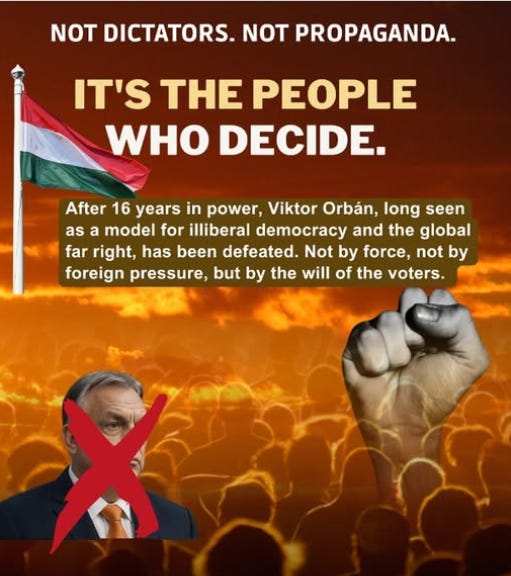
Democracy is hard

The line between Viktor Orban and Doug Ford

Doug Anderson

Apr 19, 2026

If you give people anywhere the choice of living in a free country or living in a dictatorship, they will always choose democracy in which they are consulted before decisions are made, where they elect their leaders, and where (in theory anyway) everybody has an equal voice. That’s what democracy is. The word comes from the ancient Greek words ‘demos’ (the people) and ‘kratos’ (to rule).

But, in practise, democracy is messy. Leaders want more simplicity, more certainty – less consultation, fewer meetings, streamlining. We see that right now here in Ontario where I live. Premier Doug Ford believes in democracy but his government is eliminating many school boards – because the provincial government thinks it has a better way to deliver education and “save money for the taxpayers”.

(He may have a point. School boards are … More

· · ·

Is Carney a conservative?

Why would the Ontario NDP Deputy Leader join the federal Liberals?

Doug Anderson

Feb 15, 2026

The media has changed since I was the publisher of the local newspaper – that was in the 1990s before the internet and social media. It used to be that the vast majority of journalists worked for media outlets such a newspapers, radio and TV and while those enterprises may have had a point of view and may have put more emphasis on some stories than others, generally there were standards – truth was important and sources needed to be checked.

But that has changed- newspapers began to consolidate into conglomerates and their owners began to control the tone of their papers – some stories got emphasis, others were suppressed or even eliminated. Many are now exclusively on line where readers can select the stories they want and ignore the rest. In some cases … More

· · ·

Imagine a World at peace – without the Security Council Veto

It could happen – a brave contingent of UN members have launched an effort to implement Article 109

Doug Anderson

Dec 07, 2025

We live in precarious times … not unlike the early 1960s when the cold war was at its peak. The Cuban missile crisis was 1962; The Cold War was at its height and Viet Nam was brewing.

Not unlike today.

In the early 60s while I was in high school, I was president of the World Affairs Club at my school and like 60-70 other high schools in Toronto we were participating in a model United Nations. Each school represented a different country. We met every Sunday to discuss/debate the issues of the day. I still have my copy of the UN charter.

Back then the UN was only a decade and a half old, but already it was clear that the Security Council veto was … More

· · ·

The MOU

The charade and the pipeline

Doug Anderson

Nov 29, 2025

Last week I wrote a piece that said the Carney would avoid saying “NO” to a pipeline – that he would leave the decision to the Major Projects process and that as a result of that review, no pipeline was likely to ever get built. Having read the MOU that Carney signed with Alberta Premier Danielle Smith, I stand by that assessment although not too many people agree with me.

As I’ve said before, Carney is an introvert and play the long game. He wanted to get Alberta onside with a number of environmental objectives and this MOU achieves much of that including some specific emission goals and timelines.

The Federal government acknowledges “Alberta’s approach to regulating heavy electricity generation emitters through Alberta’s Technology Innovation and Emissions Reduction (TIER) program.” “The TIER system will ramp up to a minimum … More

·

What to do about Canada Post

Doug Anderson

Oct 26, 2025

In 1968, Pierre Trudeau appointed Eric Kierans as Postmaster General in his first cabinet (it was still a cabinet position back then). Judging by the Aislin cartoon from 1970 posted on Facebook recently by the cartoonist himself, nothing much has changed.

Well, yes, a lot has changed – postal rates have gone up dramatically, mail volumes have dropped dramatically as a result of email, parcel volumes have increased dramatically and numerous non-unionized competitors have taken much of that business from the post office.,

So, what’s left. Most importantly – but diminishing every year – the monopoly that Canada Post was given on letter mail. That was supposed to be the revenue generator that would keep them in the black. That’s not working out so well these days.

Kierans made a number of operational changes which included closing post offices and discontinuing mail delivery on Saturdays … More

·

Cutting Government Waste

Where Bloat Butts up Against The Peter Principle

Prime Minister Carney laid out an ambitious program in his press conference a few days after winning the election. A lot of heavy spending predicated significantly on saving money by cutting government waste. All parties have made this promise for decades but the bloat continues. Governments just tend to be inefficient.

There was a thin little best seller book in the early 1970s entitled The Peter Principle by Laurence J. Peter. Its main thesis was that in any large hierarchical employment structure (like the civil service) people get promoted until they reach their level of incompetence. Incompetence is perhaps too blunt a term – it simply means that they can’t for whatever reason fulfill the responsibilities of their position to the degree expected. Be that as it may, we’ll stick to the term incompetent. People who have reached their “final placement” … More