
Transparency vs The Long Game
Will the real Mark Carney Please Stand up
In the current age of instant news and social media there is an expectation by the media, and by extension the general public, to know what is happening everywhere in real time. No secrets, no obfuscation, Now.
But in the complexities of the world today and the nuances of daily life, such transparency can be difficult and even misguided.
Circumstances can change on a dime. What would have seemed prudent yesterday may be ill advised today.
The media is quick to point out even minor changes in policy and will dissect them in detail.
To someone who by nature is introverted, the easiest path is to be vague … which is the antithesis of transparency. And instead of having the story about changing priorities that they were trying to uncover, the story changes to secrecy and a lack of transparency.
I’ve written several times that I think that Mark Carney is an introvert and that he is playing the long game. The media is not interested in the long game – they want a story and the only thing they can do with a long game is speculate and carp about transparency.
With almost any issue there are many ways to a satisfactory outcome, some direct and some with many twists and turns. On environmental issues the direct path is legislation “Thou shalt not pollute!”. The indirect route involves negotiation, trade offs and persuasion. Carney’s MOU with Alberta has been labelled a sellout by environmentalists but Carney maintains he got more than he gave – time will tell. I wrote many months ago about the conditions that Carney had laid out for any of his Major projects
criteria for approving such projects: These include the extent to which the project can:
- Strengthen Canada’s autonomy, resilience and security;
- Provide economic or other benefits to Canada;
- Have a high likelihood of successful execution;
- Contribute to clean growth and to Canada’s objectives with respect to climate change.
- Advance the interests of Indigenous Peoples; and
- Private sector proponent
My projection of those conditions was that if a pipeline could meet all of those conditions then there really wasn’t any reason not to build it. So far the pipeline that Danielle Smith wants has 1) no private proponent, 2) no visible acceptance by 1st nations, 3) no acceptance by British Columbia. If the major projects office sticks to the original conditions, it won’t be approved. In the meantime Premier Smith seems to be on-side (apart from the separatist issue which is another story).
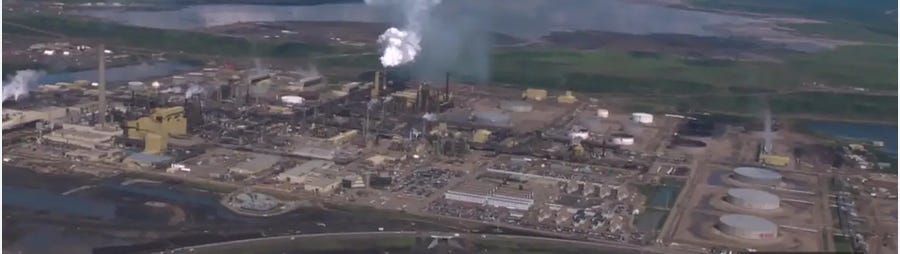
The reality is that Alberta oil sands oil is a carbon bomb and is only competitive in a very narrow market unless subsidized. This was recently said out loud.
The oil industry and Alberta want the rest of Canada to pay them to make their oil competitive.
Being open to discuss an issue in which you’ve laid out conditions doesn’t make the conditions go away.
Under the clean growth conditions, the MOU included carbon capture and storage – no carbon capture, no pipeline. Environmentalists have routinely panned carbon capture as a greenwashing pipe dream and adding it as a condition for the pipeline may have been strategic. If you were watching Canadian TV a couple of years ago you will remember the frequent TV ads from the Pathways Alliance promoting carbon capture but when the federal government proposed new anti-greenwashing legislation, the ads suddenly disappeared. Pathways went silent.
Carbon capture is certainly possible, at least to some degree (there have been a couple of pilot operations – Quest and the Alberta Carbon trunk Line – in Alberta that have sequestered about 17 million tons of CO2 since 2015. That sounds like a lot but the oil industry in Alberta currently generates more than 200 megatons CO2 equivalent greenhouse gases every single year. The Pathways plan is many orders of magnitude bigger than the pilot projects and hugely expensive. Pathways has been lobbying for government subsidies – which is highly ironic given the profitability of the industry and the already steep subsidies that they receive.
If Alberta’s pipeline to the Pacific ultimately fails because the industry refuses to undertake carbon capture, the duplicity of the industry will be laid bare. And maybe Alberta will shift its focus to clean energy like solar, wind and geothermal, all of which Alberta has potentially in spades.
The big problem with the long game is you can’t tell anybody what your plan is – even senior cabinets members “I have a plan – trust me” is about as specific it gets. Because if you tell anybody, it likely leaks out and that becomes an entirely different – and distracting – story. Even hints will lead to speculative stories. This article is just such a speculative story.
Carney has been extremely disciplined in his narrative – sufficiently so that he has lost the support of the most of the environmental movement including former Greenpeace activist and Environment Minister, Stephen Guilbeault.
Guilbeault stuck with Carney for more than a year but felt finally that he had to distance himself from the apparent anti-environment positions that Carney was taking. I suspect that they may have known each other prior to Carney winning the liberal leadership. Certainly they were well aware of each other – Guilbeault as a leading light in Greenpeace and Carney as UN Special Envoy on Climate Action and Finance.
It is possible that Guilbeault will be more useful to Carney on the outside because he can be the conscience of the environmental side of the Liberal party and keep that advocacy in the window.
I have a long record as an environmental activist and I admit I have been taken aback by Carney’s “conservative pro-oil” positions. I could be wrong but I still believe that Carney intends to get us to net zero on schedule. I hope I’m right.
