
My $7 Billion Pee & Poop Article
Nature’s Nutrient Plan – the Better Way
Apr 27, 2026
If you do any gardening … or even have a lawn, chances are you’ve bought more than a few bags of fertilizer in the past. But before there were garden centres, nature had a better way.
Animal (including humans) urine and feces are nature’s fertilizer.
Each person urinates annually about 4 kg of nitrogen, 0.4 kg of phosphorous, and nearly 1 kg of potassium; total excretion [including feces] is 4.5 kg of nitrogen, more than a half kg of phosphorous, and 1.2 kg of potassium. In an urban setting of 10 million people, this equates to 45 million kg of nitrogen, nearly 6 million kg of phosphorous, and more than 12 million kg of potassium.
That’s just the human component. The deer, bears, squirrels, birds, mice, fish, etc. contribute many times more
So for hundreds of thousands of year, bison roamed the plains of N.America mowing the grass and fertilizing it at the same time. The various herds of herbivores did the same in Africa.
If you do any driving through farm country this time of year you’ve probably passed a few fields with the distinct odour of manure. But now, most farmers buy a bunch of chemicals, and if they keep livestock, sell the manure to processors who then sell that manure to you for your garden or lawn.
In the U.S.
Liao et. al. “Realizing an equitable circular bionutrient economy in the United States.” Nature Sustainability. 2026.
Many years ago, when my wife and I bought our house in Whitby, like many people, I decided to have a garden and grow some of our food. But the soil was terrible – heavy clay. Over a period of years I worked all the leaves on the property into the soil to improve its texture. I also started composing. And I experimented with fertilizers. I have a biological sciences degree so I knew that urine has most of what we needed so I started adding that to compost bin.
I found a reference to the National Trust in England which was encouraging their male staff to relieve themselves on bales of straw which would then be used as mulch and eventually be incorporated into the soil.
I also became interested in composting toilets which take your poop and process it into rich dark fertilizer (human manure). Barely a hundred years ago everybody, including people in cities, had an outhouse which is the most basic form of a composting toilet.
I live in the oldest part of Whitby and there was evidence of an outhouse at the back of our property. In the early 2000s there were a couple of the companies in Canada that made ‘modern’ composting toilets. They supplied these toilets primarily to cottagers and the backwoods markets and were content with that. One of these companies was local and I tried to interest them in the huge potential of the urban market.
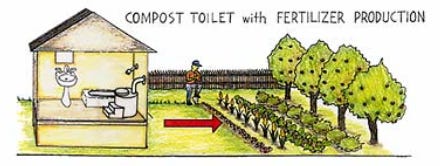
Sewage treatment is one of many environmental issues I’ve been involved with – there’s the algae problem on the lakeshore in Ajax, next door to me due to the massive Duffins Creek sewage plant across the creek in Pickering. There’s also phosphorus pollution in Lake Simcoe. At the time, York Region was planning an advanced sewage treatment plant which would extract the phosphorus using a reverse osmosis membrane system. I met with people in their Works department and suggested that if homes in new subdivisions were built with composting toilets not only would they avoid the problems of nitrogen and phosphorus being dumped into Lake Simcoe, but they would potentially produce tons of good fertilizer. People could use it in their own gardens or sell it to processing companies just like the farmers do. .
That was all 10 years ago – the advanced treatment plant was never built and both the Region and the composting toilet company ignored my proposal. York Region is now pumping all that sewage – all that phosphorus, all that muck – down to the Duffins Creek sewage plant on Lake Ontario.
But in many places sewage doesn’t get treated at all … or there are overflows when it rains too hard. It is estimated that each year, a billion gallons of raw sewage are dumped into U.S. waters. That’s 3000 gallons for each person in the United States. Composting toilets could conserve water and change this hazard into a valuable resource.
Dumping raw sewage into lakes is no longer acceptable and many of those communities are spending billions now to build sewage plants. Maybe it would be a lot cheaper to retrofit homes with composting toilets.
In my case, with a century (almost 2 centuries) house that had been modified several times, there was no practical way to install such a toilet. However there are many individual installations that have been successful and the technology keeps improving – no odour, no mess.
The C. K. Choi Building at the University of British Columbia installed a system back in the mid 1990s which had large composting tanks in the basement. The waste was mixed with wood chips and aerated regularly and only needed emptying every ten years. The system worked fine but the compost was found to contain “potential pathogens in the waste so the fertilizer did not meet provincial regulations.” In my opinion (as a microbiologist) the problem was not with the compost but rather with the regulation. All natural soil contains pathogens. Microbes are essential to good soil and some of those microbes are capable of causing disease in the right circumstances. But our society (which includes those regulators), is fixated and paranoid about ‘bugs’. Our world is full of them, billions of them – but evolution has equipped us to live in harmony with them. Most of them are beneficial.
UBC is now experimenting with a “Mycelium-Based [mushrooms] Composting Toilet” at the UBC Botanical Garden.
Our handling of human and animal waste has evolved over many millennia. We’ve known since the beginning of civilization that it could be harmful and we’ve gone from open cesspools to closed sewers leading to huge centralized sewage treatment plants, which in spite of our best efforts continue to pollute our lakes and rivers.
We’ve also known since the beginning of agriculture that pee and poop makes plants grow better – it has everything that is needed to grow more and better food. Back in the 90s, Durham Region was debating what to do with the tons of sludge that the sewage plants were accumulating. One suggestion was to turn it into fertilizer. Most of the nutrients would have been leached out and gone into the lake but it still might have been useful as an additive to heavy clay soils. Instead the Region built a dedicated incinerator to burn it and the ash went to landfill.
The environmental movement has been with us for more than 50 years and was, itself, a response to the industrialization of humanity. We polluted the air, the water, the land and even our bodies. In the last 50 years humans have gradually pushed back along with the realization that Nature really does have a better plan. The pollution has diminished, but nowhere near enough.
How we handle human and animal waste can be a win-win – much less pollution (both the waste and the chemicals that have been used to replace it) and millions of tons of of rich fertilizer with all the right nutrients.
