
Democracy is hard
The line between Viktor Orban and Doug Ford
Apr 19, 2026
If you give people anywhere the choice of living in a free country or living in a dictatorship, they will always choose democracy in which they are consulted before decisions are made, where they elect their leaders, and where (in theory anyway) everybody has an equal voice. That’s what democracy is. The word comes from the ancient Greek words ‘demos’ (the people) and ‘kratos’ (to rule).
But, in practise, democracy is messy. Leaders want more simplicity, more certainty – less consultation, fewer meetings, streamlining. We see that right now here in Ontario where I live. Premier Doug Ford believes in democracy but his government is eliminating many school boards – because the provincial government thinks it has a better way to deliver education and “save money for the taxpayers”.
(He may have a point. School boards are frequently launch points for people with higher political ambitions, but many have little actual interest or knowledge of education issues – hence long divisive meetings in which parents, teachers and the public in general try to educate them.) But the province’s plan is to simply eliminate all that – simplification, less consultation, streamlining – less democracy.
And in addition Ford has now introduced legislation that the province would appoint the chairs of the regional governments instead of having them elected – the proposed Better Regional Governance Act, 2026. In 2010 there was a referendum in Durham Region (where I live) where it was decided by voters to have an elected Chair rather than one appointed by Council. If Ford really thinks that a provincial appointee would be better, then under fundamental democratic principles he should explain his reasoning and put the decision back to the people and move forward with his plan only if they approve. But what Ford really wants is more control. Imagine the simplicity of dealing with those regional governments by simply telling them what he wants.
Ford’s actions are a case study in how democracy gets eroded and how it can lead to autocracy and eventually dictatorship.
Politicians like simplicity – centralized decision making creates better control.
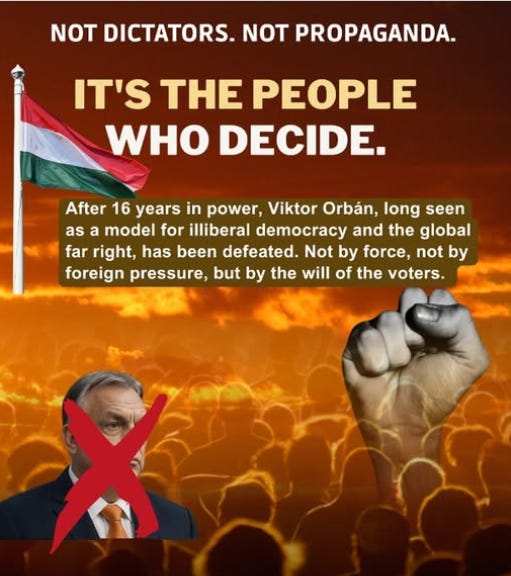
Hungary is an example. Over 16 years and several elections, democratically elected Prime Minister Viktor Orban consolidated his power.
For most of his twelve-year rule [this was written in 2022], Orbán’s base of support has hovered around a third of the electorate. Orbán has not had majority support at any point in his tenure, [but wins by swaying undecided voters] … survey respondents who answer “don’t know,” a group that sometimes comprises the majority of those polled. At election time, Orbán’s government typically rolls out massive benefits to potential supporters, and 2022 was no exception. This year, he paid a “thirteenth-month” pension to seniors, exempted people under 25 years of age from income tax, and buffered Hungarians from inflation by freezing fuel and food prices.
Media control was a central pillar of Orban’s process. The following was written after his victory in the 2022 election.
Donald Trump has been trying to use much the same process in the U.S. but has been much more ham-fisted.
So it was really exciting to see the people of Hungary vote to kick Viktor Orban out of office last weekend. What was particularly remarkable was that Orban actually conceded defeat – unlike Donald Trump who is still claiming he won the 2020 election.
Politics moves in cycles and we can hope that the Hungarian election portends the decline of right wing parties throughout the world and most importantly in Europe.
But the close call in Hungary illustrates the fragility of democracy. People get complacent and take their freedoms for granted – they stop paying attention and follow the leader. Meanwhile leaders are picking away at those freedoms – like Doug Ford and Donald Trump are doing.
Back in 1991 when the Mulroney government brought in the GST, I was still the publisher of the Whitby Free Press and I opposed the tax on the basis that they had no mandate to to make such a big change (they had campaigned in the previous election on “the second phase of tax reform” with no details).
Elections should not be interpreted as a carte blanche mandate. Democracy gives the government the right to conduct the people’s business during their term.
When the Mulroney government announced the details of the GST there was instant and overwhelming opposition (dozens of opinion polls were published almost weekly over a 6-month period which showed opposition ranging from the low 60%’s into the 90s). But Mulroney plowed ahead (he even stacked the Senate with ten extra Conservative senators in order to get it passed).
I decided to withhold the tax and announced it on the front page of the paper.
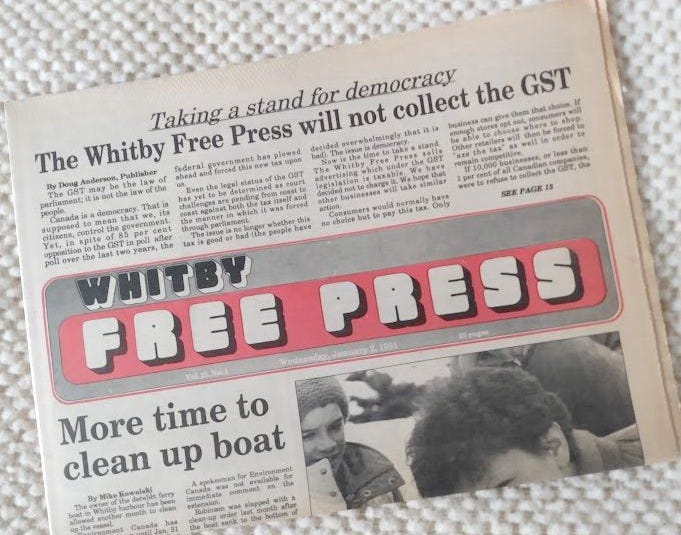
There were plenty of people who thought that such defiance should land me in jail but I knew that I was on pretty solid ground if it ever went before a judge. And the government knew that too – they never took any action and my Conservative MP continued to run occasional ads. Every invoice I sent out had a printed note saying we were withholding the tax.
I met with Morris Manning, (Henry Morgentaler’s abortion case lawyer) who felt I had a pretty strong case and would have taken it if I could raise the money ($100,000 to get it into court, a million to win it). Given the public mood, it might have been possible if there had been GoFundMe’s back then and maybe we wouldn’t be paying the GST today. I continued to withhold the tax for a year and a half.
I’m proud that I stood up to a government that was circumventing the democratic rights of their citizens. More people should. When people are complacent, democracy shrinks.
Owning a newspaper gave me a platform but it wasn’t enough. Leaders in most countries have a rocky relationship with the media – it’s the media’s job to analyze and probe the government – praise when appropriate and point out the flaws. Nobody likes criticism and politicians will naturally favour those who agree with them. If that includes shuttering dissenting voices as it did in Orban’s case, then those voices become muted.
But newspapers aren’t as important now. People throughout most of the world now have convenient access to the internet. That’s a double edged sword – on the one hand people are able to view how developments in their own country are viewed from the outside. I suspect that international coverage of Hungary’s drift towards autocracy played a role in awakening the Hungarian people’s awareness of Orban’s designs. Voter turnout rose to approx 80% up from the usual mid 60s.
But the internet also creates silos in which people see only the points of view that they want and this leads to xenophobia – anti-immigrant, anti black – anti-other which is a prominent element of right wing movements of which Orban was a guiding figure.
Right wing, autocracy-leaning leaders achieve their ends in many ways. Orban seems to have been the technocrat, gradually capturing the levers of power. Donald Trump is the mob boss who uses shakedowns to get control and Doug Ford, well he’s everybody’s folksy best friend. He tells you he’s got your back, and is doing you favours. He answers your phone calls but is gradually taking away your control.
Pay attention. Protect your rights. Push back. Your freedom depends on it.
