
Cutting Government Waste
Where Bloat Butts up Against The Peter Principle
Prime Minister Carney laid out an ambitious program in his press conference a few days after winning the election. A lot of heavy spending predicated significantly on saving money by cutting government waste. All parties have made this promise for decades but the bloat continues. Governments just tend to be inefficient.
There was a thin little best seller book in the early 1970s entitled The Peter Principle by Laurence J. Peter. Its main thesis was that in any large hierarchical employment structure (like the civil service) people get promoted until they reach their level of incompetence. Incompetence is perhaps too blunt a term – it simply means that they can’t for whatever reason fulfill the responsibilities of their position to the degree expected. Be that as it may, we’ll stick to the term incompetent. People who have reached their “final placement” are rarely aware of it and blissfully carry on.
Thanks for reading! Subscribe for free to receive new posts and support my work.
It follows that eventually all position in a hierarchy will be filled by people that are incompetent – and everything grinds to a halt. That doesn’t mean nothing is happening – there’ll be lots of meetings, discussions, reports and pencil pushing but very little measurable results.
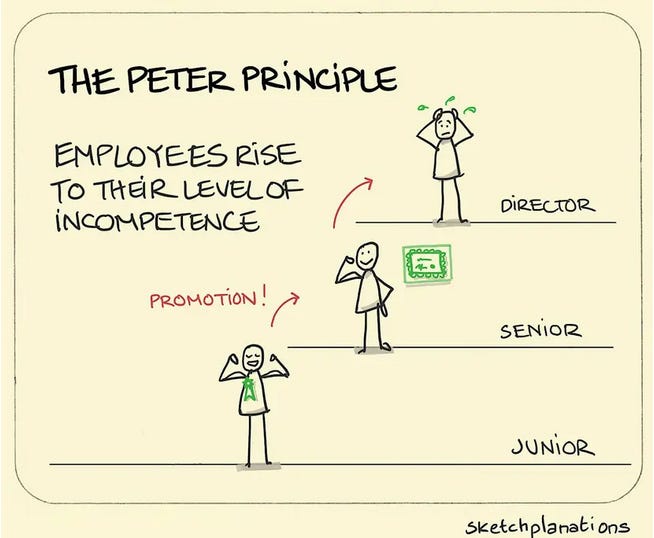
The Peter Principle makes a lot of sense. People are most often promoted on the basis of seniority – the theory being that experience at a lower level will prepare them for the next level. However, logically, experience at a level where you are following instructions from others does not necessarily give you the skills for a position where you are having to provide instructions to others
In my experience the thing that most often defines incompetence is an inability to analyze situations and implement appropriate decisions. A sequel, the Peter Prescription, came out a few years later and drew a similar conclusion. Psychologists have been studying (and quantifying) personality for close to a hundred years and they’ve found that introverts are generally better at making decisions than extroverts – and that’s just one element of the personality profile. Employers would likely get better results if they analyzed the personalities of their staff. Some companies already do.
When I was still publishing the newspaper I had many interactions with Manpower Canada (now Employment and Social Development Canada – unemployment insurance, etc) If I had a problem I would phone the Oshawa office and go through the usual rigmarole of finding somebody who can answer my question. (I’m sure you know the routine) Usually it ended up with the same person. She wasn’t even a senior manager, more mid level, but the thing she had going for her is that she was prepared to listen and then make decisions. Other in the same office would simply pass the buck, Most of them had reached their level of incompetence.
Of course these days, you frequently don’t even have a human option. They’ve been replaced by bots which give preprogrammed answers to stock questions – No phone numbers, no email address, etc.
So this is the challenge when it comes to cutting government waste. The problem is exacerbated by the ‘culture’ that it’s very difficult to get fired from a ‘permanent’ government job. The Peter Principle defines that the only people who get fired are the Super Incompetents (they make such a mess of their jobs that others have to clean up after them) and the Super Competents (who make their bosses look bad and who fire them to rid themselves of a perceived ‘competitor’. I first read The Peter Principle more than 50 years ago when I was in the process of being fired myself by an incompetent boss – she was fired herself about 6 months later.
The run-of-the mill incompetents get to keep their jobs and the system grinds to a halt.
Competent senior managers are aware of the Peter Principle and these days most new employees in the civil service are hired on contract for a fixed term so their abilities can be assessed. If everything works out, such contracts will be renewed a few times before they are offered a permanent position. That has improved the situation but it still doesn’t deal with the fact that the skills required at a entry level are vastly different from those required at a senior level.
So how do you cut the deadwood from the civil service. There’s the Elon Musk chainsaw approach to fire whole departments but the most common approach is attrition – when someone leaves or retires, they aren’t replaced. But that is entirely counter productive – it simply increases the workload for the ones left behind, many of whom are already underperforming. Then the remaining competent staff leave in frustration leaving even more workload.
Another approach is buyouts in which employees are offered generous payments if they voluntarily ‘retire’ – which the good ones do. They then get themselves hired back as consultants because somebody has to do the work. It’s not overly surprising, that when the people still on the inside have a thorny (or not so thorny) issue that needs some expertise, they would say “I know someone who could do this”, “Can we hire him”. So the deadwood accumulates while the former employee is hired back on a consultant’s wage – but without the hassles of working with the deadwood.
The problem isn’t ‘too many consultants’, but rather, Why are these people leaving? and why don’t we have people on our payroll anymore that can do the job?
The idea of a permanent ‘professional’ civil service is less than a century old. My mother grew up in Manitoba and she had an uncle who had a senior position in the Manitoba Agriculture Dept. This was the late 1920s and the practice at the time was that when a new government was elected most of the people in the civil service were fired and replaced by friends of the newly elected government (the pork barrel system). A few people like my mother’s uncle were kept because they were needed to actually do the work. The system had the advantage that the deadwood got cleaned out periodically
One of the results that followed the publication of The Peter Principal was that employers in large organizations mandated regular performance reviews on all employees – which was good in principle but the reality was different. Reviews tended to skirt around the real issues because they were awkward and may have been more of a reflection on the supervisor doing the review).
There is no doubt that our civil service suffers from bloat so how should we correct this situation without blowing the system up? Here’s a couple of observations:
- Employees should not be promoted into positions where they lack the necessary skills! Period, Full Stop, Exclamation Mark
- Positions in the civil service should be tiered according to the level of responsibility, decision making, supervision ability, etc. and positions should be defined in terms of these parameters. Advancement to a new level would require that they can meet those parameters – which should be determined based on professional testing.
- Employees should get paid according to their seniority regardless of their tier. Thus, if an employee is doing a good job at their current level and is happy there, they can remain there rather than move into a higher tier requiring skills that they don’t have. They would still get the salary increases (which might mean they could be getting paid more than someone in a higher tier).
- Staff who are found to be performing poorly should be allowed to move downward into positions they used to do well with no loss in pay.
The public sector unions would most likely push back on this approach but if it results in people staying in positions they can perform well and are happy in, then everybody wins, especially taxpayers.
If you have other ideas or want to provide any comments or suggestions please put them in the comments.
I’m sure that PM Carney has been around governments long enough that he is well aware of the problem. Let’s hope he has some solutions.
